Wolf vs. Panther: A Complete Predator Comparison
Published: 19 Feb 2026
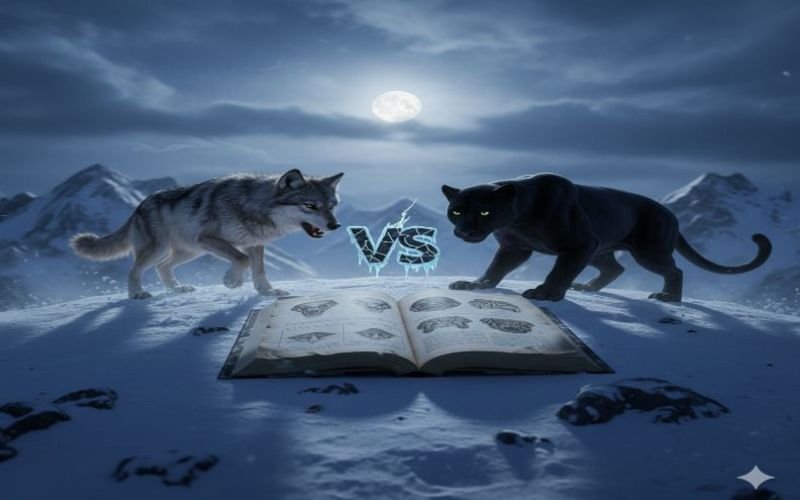
Few comparisons in the natural world are as compelling as the wolf versus the panther. One is a social architect, built for endurance and cooperation. The other is a solitary ghost, built for silence and sudden, lethal precision. Both represent the absolute peak of their evolutionary lineages , and both have shaped human mythology, ecology, and imagination for thousands of years.
This guide examines them across every meaningful dimension: biology, habitat, hunting strategy, social behaviour, and cultural significance , along with the important clarification about what “panther” actually means scientifically.
What Is a Panther? A Necessary Clarification
Before comparing these two animals, it is worth addressing a common misconception. “Panther” is not a distinct species , it is a colloquial term applied to several large cats exhibiting melanism, a genetic condition that causes an overproduction of dark pigment. In practice, a panther is usually either a melanistic jaguar (Panthera onca) in the Americas, or a melanistic leopard (Panthera pardus) in Africa and Asia. The rare “Florida panther” is actually a subspecies of cougar (Puma concolor), which is not melanistic at all.
This distinction matters for the comparison, because jaguar-panthers and leopard-panthers differ in size, habitat, and behaviour. For this article, we primarily reference the melanistic jaguar and melanistic leopard as the archetypal “panther” , the large, dark, ambush-hunting cats most people picture when they hear the word.
The wolf we compare against is the grey wolf (Canis lupus), the most widespread and well-studied wolf species in the world.

Comparison at a Glance
| Aspect | Wolf (Canis lupus) | Panther (melanistic jaguar/leopard) |
| Scientific Family | Canidae | Felidae |
| Average Weight | 70–130 lbs (32–59 kg) | 60–250 lbs (27–113 kg) |
| Body Build | Lean, long-limbed, built for endurance | Compact, muscular, built for explosive power |
| Coat | Thick double coat; grey, black, white, or tawny | Short, dense; appears black due to melanism |
| Habitat | Forests, tundra, mountains, grasslands | Rainforests, savannas, scrublands, subtropical forests |
| Territory | 50–1,000+ sq miles (pack territory) | 10–400 sq miles (solitary) |
| Social Structure | Pack-based, hierarchical | Solitary |
| Hunting Strategy | Cooperative endurance pursuit | Solitary ambush |
| Top Speed | ~37 mph (60 km/h) | ~50 mph (jaguar); ~36 mph (leopard) |
| Bite Force | ~400 PSI | ~1,500 PSI (jaguar); ~300 PSI (leopard) |
| Lifespan (wild) | 6–8 years | 10–15 years |
| Conservation Status | Least Concern (some subspecies threatened) | Vulnerable (jaguar); Vulnerable (leopard) |
Physical Characteristics
The grey wolf is a canine built for the long game. Its body is lean and athletic, with long legs for covering ground, deep-set chest for lung capacity, and a thick double-layered coat that insulates against temperatures well below freezing. Its skull is elongated, housing powerful jaw muscles capable of crushing bone , an adaptation for consuming prey entirely, waste-free. Adult males in North America typically weigh between 70 and 130 pounds, with wolves in the far north running larger.
The panther’s physique tells a different story entirely. The jaguar , the largest cat in the Americas and the likely basis for most “panther” imagery , is an extraordinary combination of mass and agility. Heavily muscled through the shoulders and jaw, it possesses the most powerful bite of any big cat relative to its size, capable of piercing turtle shells and crocodilian skulls. The leopard is more lightly built but proportionally even stronger, capable of hauling prey twice its own weight up into a tree. The melanistic coat that defines the “panther” appearance is a recessive gene variant that provides no proven advantage in the wild, though it may offer marginal camouflage benefits in dense forest at night.
Habitat and Range
Grey wolves are among the most habitat-adaptable large predators on Earth. They have historically ranged across virtually the entire northern hemisphere , from Arctic tundra and boreal forest to desert and grassland. Today, following centuries of persecution, their range is fragmented, but recovery efforts (most famously the reintroduction of wolves to Yellowstone National Park in 1995) have demonstrated both their ecological importance and their resilience.
Panthers , depending on species , occupy dramatically different biomes. Melanistic jaguars are concentrated in the dense rainforests of the Amazon basin and Central America, where the dark coat provides genuine concealment in low-light conditions. Melanistic leopards are found across sub-Saharan Africa and southern Asia, with particularly high frequencies in the moist forests of Malaysia and Sri Lanka. Both prefer environments with reliable cover and abundant prey, and both are under pressure from habitat loss and fragmentation.
Hunting Strategies: Endurance vs. Ambush
The wolf’s hunting method is one of the most sophisticated in the animal kingdom. A pack does not simply chase prey , it reads the landscape, tests the herd, identifies the weakest individual, and then deploys a coordinated pursuit that can last for hours across many miles. Communication is continuous throughout: wolves signal through posture, vocalisation, and eye contact. The eventual kill is collaborative, with different pack members playing distinct roles. This strategy allows wolves to reliably take prey , elk, bison, moose , many times their own size.
The panther operates on entirely opposite principles. Where the wolf relies on stamina and numbers, the panther relies on absolute silence and a single moment of devastating force. A hunting panther may stalk prey for thirty minutes or more, closing the distance inch by inch, before launching an attack from within a few metres. The jaguar kills with a unique technique , a direct bite to the skull or cervical spine rather than the throat suffocation used by lions and leopards. Death is usually immediate. If the ambush fails, the jaguar rarely pursues; it conserves energy and waits for the next opportunity.
These contrasting strategies reflect a broader division in carnivore evolution: pursuit predators (wolves, African wild dogs, cheetahs) invest in endurance and cooperation; ambush predators (cats, crocodilians) invest in concealment and raw power. Neither approach is superior , both are extraordinarily successful.

Social Structure and Intelligence
Wolf pack society is among the most studied animal social systems in the world, and popular understanding of it has undergone significant revision in recent decades. The concept of a rigid “alpha/beta/omega” hierarchy enforced through dominance comes primarily from studies of captive wolves; research on wild packs shows a more fluid and cooperative structure, typically organised around a breeding pair and their offspring. Leadership emerges naturally from experience and family role rather than constant status competition.
Wolf intelligence is considerable. Packs adapt hunting strategies to specific prey, terrain, and season. Individual wolves have been documented solving novel problems and learning by observation. Their vocal repertoire , howls, barks, growls, whines , encodes complex information about identity, location, and emotional state, and howls can be heard by other wolves up to 10 miles away.
Panthers, as solitary animals, have no need for the social intelligence that makes wolves remarkable. Their intelligence is directed inward , toward reading prey behaviour, memorising territory, and assessing risk. Leopards in particular have demonstrated remarkable flexibility and problem-solving in human-dominated landscapes, thriving in environments where other large carnivores have long since disappeared. Jaguars, while more dependent on intact wilderness, are powerful swimmers and have been documented crossing rivers several miles wide.
Ecological Role: Keystone Species
Both animals are apex predators with outsized ecological importance. The wolf’s reintroduction to Yellowstone triggered what ecologists call a “trophic cascade” , the presence of wolves changed elk behaviour, which reduced overgrazing of riverbanks, which allowed vegetation to recover, which stabilised stream banks, which improved water quality and habitat for fish, birds, and beaver. This chain reaction, documented over decades, has become one of the most cited examples of how apex predators regulate entire ecosystems.
Jaguars and leopards perform analogous roles in their respective ecosystems , regulating prey populations, preventing herbivore overgrazing, and maintaining the balance between species at every level of the food web. The loss of either from an ecosystem produces measurable cascading effects that can destabilise it significantly.
Conservation Status
Both animals face serious conservation pressures, though from different directions. Wolf populations, having been dramatically reduced through deliberate extermination campaigns in the 19th and 20th centuries, have partially recovered in North America and parts of Europe thanks to legal protection and active reintroduction. However, they remain politically controversial, and in many regions their recovery is contested by ranching and farming interests.
Jaguars are listed as Vulnerable on the IUCN Red List, with a population estimated at fewer than 64,000 individuals and declining, primarily due to deforestation in the Amazon basin and Cerrado. Leopards, while more numerous, have lost more than 75% of their historic range and face serious pressure from habitat loss, prey depletion, and poaching. For current information on the conservation status of both species, the IUCN Red List is the authoritative source.
Cultural Symbolism
Wolves have occupied the human imagination since prehistory. In Norse mythology, the great wolf Fenrir was a force powerful enough to threaten the gods themselves. In Roman mythology, a she-wolf nursed Romulus and Remus, the founders of Rome. Across Indigenous cultures of North America, the wolf appears as teacher, guide, and emblem of loyalty. In European folklore, the wolf became a symbol of danger and wildness , the antagonist of countless fairy tales , a projection of fear onto a misunderstood animal.
The panther’s symbolism is equally ancient and cross-cultural. In Mesoamerican civilisations, the jaguar was associated with the night sky, the underworld, and royal power , Aztec warriors formed elite jaguar orders. In West African traditions, the leopard symbolises kingship and controlled ferocity. Across cultures, the panther’s association with darkness, stealth, and hidden power has made it a consistent emblem of mystery and the uncanny.
Wolf vs. Panther: Who Would Win in a Direct Encounter?
It is a question that captures imagination, so it deserves a direct answer. In a one-on-one encounter between a single wolf and a large jaguar-panther, the jaguar wins decisively. A large male jaguar outweighs a wolf significantly, possesses a bite force roughly three to four times greater, and has the element of surprise as its primary weapon. A wolf engaging a jaguar alone would be at an enormous disadvantage.
The calculation changes entirely with a pack. A full wolf pack coordinating against a single panther is a very different proposition , the wolf’s evolutionary advantage is precisely that it is never truly alone. But this is less a measure of individual capability than of ecological strategy: the jaguar evolved to operate alone; the wolf evolved never to need to.
The more illuminating question is not who wins a fight, but who is better adapted to their environment. The answer, in both cases, is: completely.
Final Thoughts
The wolf and the panther are not rivals in any meaningful natural sense , their ranges rarely overlap, and their ecological roles are complementary rather than competitive. What makes comparing them valuable is what it reveals about the two great strategies through which predators have conquered the natural world: cooperation and stealth. One animal demonstrates what becomes possible when individuals surrender autonomy to collective purpose. The other demonstrates what becomes possible when an individual achieves near-perfect self-sufficiency.
Both are essential. Both are endangered by the same force , human expansion into wild spaces. And both, if we choose to protect them, will continue to regulate the ecosystems that ultimately sustain us as well.






- Be Respectful
- Stay Relevant
- Stay Positive
- True Feedback
- Encourage Discussion
- Avoid Spamming
- No Fake News
- Don't Copy-Paste
- No Personal Attacks
- Be Respectful
- Stay Relevant
- Stay Positive
- True Feedback
- Encourage Discussion
- Avoid Spamming
- No Fake News
- Don't Copy-Paste
- No Personal Attacks
