Top Love Poets in Urdu: Timeless Masters of Romance
Published: 19 Feb 2026
Urdu poetry occupies a singular place in world literature , a richly woven tapestry of emotion, metaphor, and musical cadence. Among its many traditions, love poetry stands as its most enduring thread. Urdu love poets have created verses that transcend time and geography, speaking to the universal human experience of longing, devotion, and heartbreak. Whether you are a lifelong student of Urdu literature or encountering it for the first time, these poets offer a gateway into one of the world’s most expressive literary traditions.
The Essence of Love in Urdu Poetry
Love (ishq) in Urdu poetry is far more than a personal emotion , it is a metaphysical journey. Rooted in the Sufi tradition, Urdu love verse frequently blurs the boundary between earthly romance and spiritual longing, using the beloved as a symbol of the divine. Poets employ rich imagery , the moth drawn to a flame, the nightingale pining for the rose , to convey desire, separation (hijr), and union (wisal) with extraordinary depth.
This tradition grew primarily in the Mughal courts of Delhi and Lucknow and has since evolved into a living literary form still practiced and celebrated across South Asia and the diaspora. To understand the roots of this tradition, the Rekhta Foundation remains the most comprehensive digital archive of classical and contemporary Urdu poetry in the world.
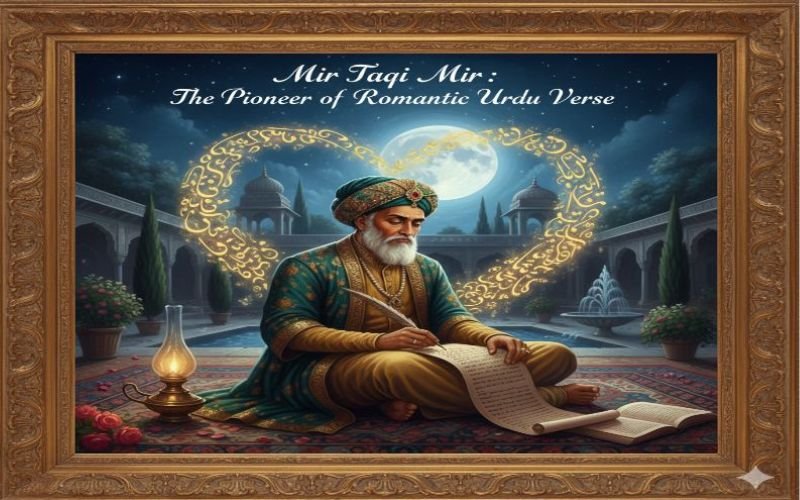
Mir Taqi Mir: The Pioneer of Romantic Urdu Verse
Mir Taqi Mir (1723–1810) is widely regarded as the foundational voice of Urdu ghazal. Often called the Khuda-e-Sukhan (God of Poetry), Mir brought an unprecedented rawness and vulnerability to romantic verse. His couplets explore grief, unfulfilled love, and the quiet devastation of longing with a simplicity that cuts deep. Unlike the ornate style of some contemporaries, Mir’s language was closer to everyday speech, making his pain feel personal and immediate.
His influence on later poets , including Ghalib, who famously acknowledged Mir as his master , is incalculable.
دیکھ تو دل کہ جاں سے اٹھتا ہے یہ دھواں سا کہاں سے اٹھتا ہے
پہنچی وہیں پہ خاک جہاں کا خمیر تھا میرا ہی دل تھا خواب و خیالِ اسیر تھا
Why he matters today: Mir’s emotional directness resonates powerfully with modern readers who value authenticity over artifice. His kulliyat (collected works) are available in full on Rekhta’s Mir Taqi Mir page.
Mirza Ghalib: The Master of Love and Longing
Mirza Asadullah Khan Ghalib (1797–1869) is arguably the most celebrated name in all of Urdu literature. His poetry is an intricate dance between wit and sorrow, philosophy and desire. Ghalib treated love as an intellectual puzzle as much as an emotional state , his verses invite repeated reading, revealing new layers of meaning each time.
What sets Ghalib apart is his refusal to sentimentalize. His heartbreak is laced with irony; his longing carries a cool philosophical detachment. This paradox makes him endlessly quotable and endlessly relevant.
دل ہی تو ہے نہ سنگ و خشت، درد سے بھر نہ آئے کیوں روئیں گے ہم ہزار بار، کوئی ہمیں ستائے کیوں
یہ نہ تھی ہماری قسمت کہ وصالِ یار ہوتا اگر اور جیتے رہتے، یہی انتظار ہوتا
Ghalib’s letters (khutut) are also considered literary masterpieces, providing remarkable context for understanding the man behind the verse. For a scholarly introduction, Columbia University’s South Asia Institute offers useful academic resources on classical Urdu literature.
Allama Iqbal: Philosophy Intertwined with Passion
Sir Muhammad Iqbal (1877–1938) is best known as the “Poet of the East” and the philosophical father of Pakistan. Yet within his vast body of work lies a deeply felt exploration of love , not as weakness, but as a transformative, even cosmic force. For Iqbal, ishq was the antidote to stagnation, the energy that propels both the individual and civilizations forward.
His love poetry transcends romance, connecting personal passion to questions of selfhood (khudi), spiritual awakening, and humanity’s place in the universe.
وجودِ زن سے ہے تصویرِ کائنات میں رنگ اسی کے ساز سے ہے زندگی کا سوزِ دروں
محبت مجھے ان جوانوں سے ہے ستاروں پہ جو ڈالتے ہیں کمند
The Iqbal Academy Pakistan is the authoritative source for his complete works, translations, and scholarly commentary.
Faiz Ahmed Faiz: Romance in the Time of Revolution
Faiz Ahmed Faiz (1911–1984) brought an entirely new dimension to Urdu love poetry by fusing personal longing with political consciousness. A Marxist and revolutionary, Faiz wrote from prison cells and exile, and his beloved (mehboob) was as often an emblem of justice and freedom as a real person. This ambiguity is precisely what gives his poetry such lasting resonance.
His verse is musical, lyrical, and charged with a controlled emotional intensity that has made him the most frequently sung Urdu poet of the modern era.
گلوں میں رنگ بھرے بادِ نو بہار چلے چلے بھی آؤ کہ گلشن کا کاروبار چلے
دل سے تو ہر معاملہ کر کے گزر گئے حیرت ہے پھر بھی مجھ پہ تیرے دل میں غم رہا
Faiz received the Lenin Peace Prize in 1962 and was nominated for the Nobel Prize in Literature. His work has been translated into dozens of languages and continues to be performed by musicians from Noor Jehan to Abida Parveen.
Parveen Shakir: The Feminine Voice of Love
Parveen Shakir (1952–1994) transformed Urdu love poetry by centering the woman’s gaze , her desire, her vulnerability, and her agency , with a clarity and honesty that was revolutionary for her time. A civil servant by profession and a poet by calling, she wrote with deceptive simplicity that conceals profound emotional intelligence.
Her debut collection Khushbu (Fragrance), published in 1976, was immediately recognized as a landmark work. She gave voice to experiences that had long been felt but rarely spoken: the quiet ache of unexpressed love, the complexity of modern relationships, the tension between tradition and selfhood.
خوشبو کی طرح دل میں اتر جاۓ گا یہ سوچ کے ہم اسے بھلا دیتے ہیں
وہ تو خوشبو ہے، ہوا میں بکھر جائے گا مسئلہ پھول کا ہے، پھول کدھر جائے گا
Her death in a car accident at 42 cut short a voice that was still very much in its prime. She remains one of the most widely read female poets in the Urdu language.
Ahmed Faraz: Elegance and Simplicity in Romance
Ahmed Faraz (1931–2008) occupies a unique position in Urdu poetry , a bridge between the classical and the contemporary. His love poetry is immediately accessible yet never shallow, combining conversational warmth with lyrical elegance. Faraz wrote of love with directness and tenderness, avoiding both the obscure metaphysics of some classical poets and the sentimentality that can plague modern verse.
His couplets became anthems for a generation, widely memorized, recited at gatherings, and shared , long before the age of social media , as expressions of feeling that words alone couldn’t carry.
سنا ہے لوگ اسے آنکھ بھر کے دیکھتے ہیں تو اس کے شہر میں کچھ دن ٹھہر کے دیکھتے ہیں
اب کے ہم بچھڑے تو شاید کبھی خوابوں میں ملیں جس طرح سوکھے ہوئے پھول کتابوں میں ملیں
The Influence of Urdu Love Poetry on Modern Culture
The reach of these poets extends far beyond the written page. Their verses have shaped Bollywood and Pakistani film music for decades , ghazals by Ghalib and Faiz have been set to music by artists ranging from Mehdi Hassan and Ghulam Ali to modern fusion performers. Contemporary novelists writing in English , including Mohsin Hamid and Kamila Shamsie , acknowledge Urdu poetic tradition as a formative influence on their prose.
In the digital age, platforms like Rekhta and the Urdu Poetry Archive have introduced these poets to global audiences, with millions of readers discovering Ghalib and Faiz for the first time through social media and streaming platforms. Academic interest has also grown significantly, with universities across North America and Europe now offering dedicated courses in Urdu literary studies.

How to Begin Reading Urdu Love Poetry
For new readers, the best entry point depends on your goals. If you want emotional accessibility, start with Ahmed Faraz or Parveen Shakir , both write in a modern idiom that requires little cultural background. For greater depth and philosophical richness, Ghalib rewards patience and repeated reading. Faiz is ideal for those drawn to the intersection of politics and lyricism, while Mir Taqi Mir offers a window into the classical tradition at its most raw and affecting.
Bilingual editions with transliteration are widely available and highly recommended for those who do not read the Nastaliq script. The translator Frances Pritchett’s annotated translations of Ghalib, freely available at Columbia University’s digital resource, are considered among the finest scholarly resources on the subject in English.
The Enduring Legacy of Urdu Love Poetry
What makes Urdu love poetry genuinely timeless is not its historical prestige but its emotional truth. These poets , writing across three centuries, through empires and partitions, revolutions and exiles , captured something permanent about what it means to love and to lose. Their words remain a source of solace, beauty, and profound self-recognition for millions of readers around the world.
In an era of abbreviated communication and fleeting attention, the depth and care these poets brought to the language of the heart feel more necessary than ever.






- Be Respectful
- Stay Relevant
- Stay Positive
- True Feedback
- Encourage Discussion
- Avoid Spamming
- No Fake News
- Don't Copy-Paste
- No Personal Attacks
- Be Respectful
- Stay Relevant
- Stay Positive
- True Feedback
- Encourage Discussion
- Avoid Spamming
- No Fake News
- Don't Copy-Paste
- No Personal Attacks
