How to Read Qaza Namaz for Zuhr: A Complete Step-by-Step Guide
Published: 5 Mar 2026
Among the five daily prayers, Zuhr holds a central place , performed in the early afternoon, it marks a spiritual pause at the heart of the day. When Zuhr is missed, the obligation does not simply expire. Islam, in its mercy and practicality, provides the institution of Qaza , the making up of missed obligatory prayers , as a means of fulfilling what was due and seeking Allah’s forgiveness.
This guide explains what Qaza Namaz is, when Zuhr becomes Qaza, and provides a complete, step-by-step method for performing it correctly, including the Niyyah (intention), the full Rakat structure, and guidance on combining missed prayers.
What Is Qaza Namaz?
Qaza (also written Qadha) refers to a Salah that was not performed within its prescribed time and must now be made up. The Arabic root q-d-a (قضاء) relates to fulfilment of an obligation , the Qaza prayer is the discharge of a duty that was not fulfilled in its appointed window.
Islamic scholars across all major schools of jurisprudence (Hanafi, Shafi’i, Maliki, and Hanbali) agree that missed obligatory prayers must be made up. The Prophet Muhammad ﷺ established this clearly:
“Whoever forgets a prayer, or sleeps through it, let him pray it when he remembers it. There is no expiration other than that.” (Sahih al-Bukhari, Hadith 597; Sahih Muslim, Hadith 684)
This Hadith provides both the obligation and the compassion embedded in it: the door to making up missed prayers is always open. What is important is sincere intention and action upon remembering.
When Does Zuhr Prayer Become Qaza?
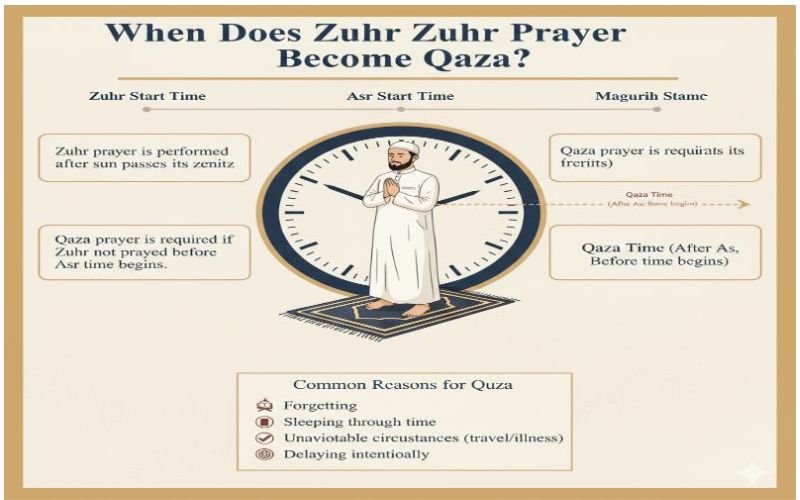
The time for Zuhr prayer begins when the sun passes its zenith (midday peak) and ends when the shadow of an object equals the object’s own length , at which point the time of Asr begins. In practical terms, this typically means Zuhr time runs from approximately 12:30 PM to 3:30–4:00 PM, depending on location and season.
If Zuhr was not performed before Asr time entered, it has become Qaza and must be made up as soon as possible.
Note on combining prayers: The Prophet ﷺ did permit combining Zuhr and Asr (known as Jam’ , جمع) in specific circumstances:
“The Prophet ﷺ combined the Zuhr and Asr prayers during travel, and during rain.” (Sahih Muslim, Hadith 705)
Most Hanafi scholars hold that combining prayers is only permissible during Hajj (at Arafat and Muzdalifah) and during genuine travel under specific conditions. The Shafi’i, Maliki, and Hanbali schools permit combining during travel and illness more broadly. For regular missed prayers outside these circumstances, Qaza is the prescribed remedy.
It is advisable to follow the guidance of your own school of jurisprudence (madhab) on this matter. If uncertain, consulting a qualified local scholar is always the most sound approach.
Preparation Before Performing Qaza Namaz
Before beginning any Salah , including Qaza , the following prerequisites must be fulfilled:
1. Tahara (Purity) Ensure you are in a state of ritual purity. Perform Wudu (ablution) thoroughly if it has been broken, or Ghusl (full ritual bath) if required. Salah is not valid without proper purification.
2. Clean clothing and place Your clothes, the surface you pray on, and your body must be free of najasa (ritual impurity). A prayer mat is ideal, but any clean surface suffices.
3. Facing the Qibla Stand facing the direction of the Kaaba in Makkah. In Pakistan, the Qibla direction is approximately west-northwest. Most mosques, prayer apps, and built-in phone compasses can assist with finding the exact direction.
4. Correct time There are three prohibited times during which no Salah , including Qaza , should be performed: at sunrise, when the sun is at its zenith (midday peak, for approximately 5 minutes), and at sunset. Avoid performing Qaza during these windows.
5. Niyyah (Intention) The intention must be made in the heart before beginning. It does not need to be spoken aloud, though saying it quietly is permissible. The key is that the heart is consciously aware of which prayer is being performed and for whose sake.
Niyyah for Qaza Namaz of Zuhr
The intention for Qaza Zuhr may be made as follows (in Arabic, or in your own language , the heart’s intention is what counts):
In Arabic: “Nawaytu an usalliya lillahi ta’ala arba’a raka’atin qadha’a salati’l-Zuhri, mustaqbilan il-qiblata, Allahu Akbar.”
In English: “I intend to perform four Rakats of the Qaza of Zuhr prayer, for the sake of Allah, facing the Qibla.”
If you are making up multiple missed Zuhr prayers and are unsure of the exact number, the intention can be: “I intend to perform the first/last Qaza Zuhr prayer still owed to me, for the sake of Allah.”
Hanafi scholars recommend that when making up multiple missed prayers, the intention specifies either “the first missed Zuhr” or “the last missed Zuhr” in sequence, to maintain proper order (tartib).
Step-by-Step Guide to Performing Qaza Namaz for Zuhr
Zuhr consists of 4 Fard (obligatory) Rakats. The Qaza is performed in the same manner as the regular Fard Zuhr , with recitation in the regular (silent) tone, since Zuhr is a silent prayer.
First Rakat
- Stand upright facing the Qibla, having made your Niyyah.
- Raise both hands to your earlobes (men) or shoulders (women) and say “Allahu Akbar” (Takbir-e-Tahreema). This formally opens the Salah.
- Fold your hands , right over left , below the navel (Hanafi) or on the chest (other madhabs).
- Recite Thana (Subhanakallahumma…): “Subhanakallahumma wa bihamdika wa tabarakasmuka wa ta’ala jadduka wa la ilaha ghairuk.”
- Recite Ta’awwudh (A’udhu billahi minash-shaytanir-rajeem) and Bismillah silently.
- Recite Surah Al-Fatiha (obligatory in every Rakat).
- Recite any additional Surah or verses from the Quran (at least three short verses or one long verse in the first two Rakats , silent recitation for Zuhr).
- Proceed to Ruku (bowing): say “Allahu Akbar,” bow with your back flat, hands on knees, and recite “Subhana Rabbiyal Azeem” three times.
- Rise saying “Sami Allahu liman hamidah”, then say “Rabbana lakal hamd” while standing upright.
- Proceed to the first Sajda (prostration): say “Allahu Akbar,” place forehead, nose, both palms, both knees, and toes on the ground, recite “Subhana Rabbiyal A’la” three times.
- Rise to the sitting position (Jalsa) saying “Allahu Akbar,” pause briefly.
- Perform the second Sajda in the same manner.
- Rise to begin the second Rakat saying “Allahu Akbar.”
Second Rakat
- Recite Bismillah, then Surah Al-Fatiha, followed by an additional Surah or verses (silent).
- Complete Ruku, standing, and two Sajdas as in the first Rakat.
- After the second Sajda, remain seated for At-Tahiyyat (Qa’da-e-Ula , the first sitting).
- Recite Tashahhud: “At-tahiyyatu lillahi wassalawatu wattayyibatu. Assalamu ‘alaika ayyuhan-nabiyyu wa rahmatullahi wa barakatuh. Assalamu ‘alayna wa ‘ala ‘ibadillahis-salihin. Ash-hadu alla ilaha illallah wa ash-hadu anna Muhammadan ‘abduhu wa rasuluh.”
- At the word “illallah” in the Tashahhud, raise your right index finger and lower it again.
- Rise to the third Rakat saying “Allahu Akbar.”
Third Rakat
- Recite Bismillah and Surah Al-Fatiha only (no additional Surah in the third and fourth Rakats in Hanafi practice; other madhabs may differ).
- Complete Ruku and two Sajdas as before.
- Rise to the fourth Rakat saying “Allahu Akbar.”
Fourth Rakat
- Recite Bismillah and Surah Al-Fatiha only.
- Complete Ruku and two Sajdas.
- Remain seated for the final Qa’da (Qa’da-e-Akhira).
- Recite the full Tashahhud.
- Recite Durood Ibrahim (Salawat upon the Prophet ﷺ): “Allahumma salli ‘ala Muhammadin wa ‘ala ali Muhammadin, kama sallayta ‘ala Ibrahima wa ‘ala ali Ibrahima, innaka Hamidun Majeed. Allahumma barik ‘ala Muhammadin wa ‘ala ali Muhammadin, kama barakta ‘ala Ibrahima wa ‘ala ali Ibrahima, innaka Hamidun Majeed.”
- Recite a Du’a (supplication) , the traditional closing supplication is: “Allahumma inni zalamtu nafsi zulman kathiran, wa la yaghfirudh-dhunuba illa anta, faghfirli maghfiratan min ‘indika, warhamni, innaka antal-Ghafurur-Rahim.”
- Complete the Salah with Salam: turn your head to the right saying “Assalamu Alaikum wa Rahmatullah”, then to the left with the same.
The Qaza Namaz for Zuhr is now complete.
Combining Missed Zuhr and Asr as Qaza
If both Zuhr and Asr were missed in the same day, it is recommended to perform them consecutively as Qaza, maintaining their original order (tartib):
- Perform the 4 Rakats of Qaza Zuhr first, with the intention clearly for Zuhr.
- Immediately after completing Zuhr, stand and perform the 4 Rakats of Qaza Asr, with the intention clearly for Asr.
There is no requirement for a gap between them , you may perform Qaza of multiple prayers back to back. However, your intention for each must be distinct and clear before beginning each prayer.
How Many Missed Prayers Do You Owe? The Question of Multiple Qaza
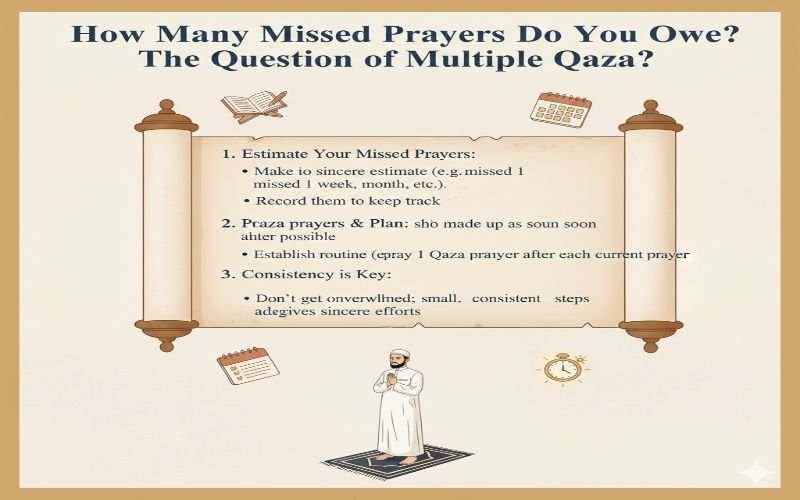
For those who have accumulated many missed prayers over months or years , a situation known in Hanafi jurisprudence as having a dhimma (debt of prayers) , the process of making them up requires consistency rather than perfection.
A practical approach endorsed by many scholars is to perform one or two Qaza prayers after each regular prayer, gradually clearing the debt. For example, after each regular Salah, perform one Qaza of the corresponding prayer from your backlog. This method, maintained consistently, works through the missed prayers steadily without overwhelming your regular worship routine.
Keeping a simple written count of how many prayers remain owed is strongly recommended for those with a significant number of missed Salah.
The Spiritual Significance of Qaza Namaz
Performing Qaza is not merely a technicality. It is an act of accountability , an acknowledgement before Allah that an obligation was missed, and a sincere effort to fulfil it despite the lateness. The Prophet ﷺ modelled this himself:
“The Prophet ﷺ, on the occasion of the Battle of the Trench, missed four prayers. He performed them in order after the battle ended, each by its name.” (Sunan an-Nasa’i, Hadith 661)
This narration illustrates that even the Prophet ﷺ , in circumstances of genuine constraint , made up missed prayers as soon as circumstances allowed, performing them in order and with full intention.
Allah says in the Quran:
“Indeed, prayer has been decreed upon the believers by a decree of specified times.” (Surah An-Nisa, 4:103)
This verse establishes the primacy of praying in time. But the Prophet’s ﷺ practice establishes that when the time has passed, the obligation does not simply vanish , it remains, to be fulfilled as soon as it is remembered.
Common Questions About Qaza Namaz
Can Qaza be performed at any time of day? Yes, except during the three prohibited times: at sunrise, when the sun is directly overhead (midday peak), and at sunset. At all other times, Qaza may be performed.
Should Qaza be performed before the next regular prayer? If you have only a small number of missed prayers, it is recommended to perform them before the next Salah if time permits. If you have many, establish a consistent routine and perform them alongside your regular prayers.
Is the Sunnah of Zuhr also owed as Qaza? According to the majority Hanafi position, only the Fard (obligatory) Rakats are owed as Qaza. The Sunnah prayers that were missed alongside the Fard do not carry a Qaza obligation, though some scholars recommend making them up as well as a virtuous act.
What if I am unsure of exactly how many prayers I have missed? Make a sincere and reasonable estimate, intend to fulfil as many as you believe you owe, and continue making up prayers with consistency. Allah knows the sincerity of the intention.
A Final Note
The institution of Qaza reflects one of the fundamental qualities of Islamic jurisprudence , that obligation and mercy are not opposites. The duty to pray in its time is serious. The provision to make up what was missed is compassionate. Together they reflect Allah’s description of the faith: “Allah intends ease for you and does not intend hardship for you.” (Surah Al-Baqarah, 2:185)
Performing Qaza Namaz with sincerity, consistency, and humility is an act of deep spiritual integrity , the recognition of a debt and the determination to repay it.






- Be Respectful
- Stay Relevant
- Stay Positive
- True Feedback
- Encourage Discussion
- Avoid Spamming
- No Fake News
- Don't Copy-Paste
- No Personal Attacks
- Be Respectful
- Stay Relevant
- Stay Positive
- True Feedback
- Encourage Discussion
- Avoid Spamming
- No Fake News
- Don't Copy-Paste
- No Personal Attacks
