Astronomical Phenomena: The Science Behind the Universe’s Greatest Events
Published: 4 Mar 2026
The universe is not a static backdrop. It is an arena of constant, often violent, always extraordinary activity , stars exploding, galaxies colliding, planets crossing the faces of suns, and particles from 93 million miles away painting our own skies with light. Astronomical phenomena are the moments when this activity becomes visible to us, and they range from the deeply intimate (a meteor burning above your backyard) to the barely comprehensible (a gamma-ray burst releasing more energy in a second than our Sun will emit across its entire ten-billion-year life).
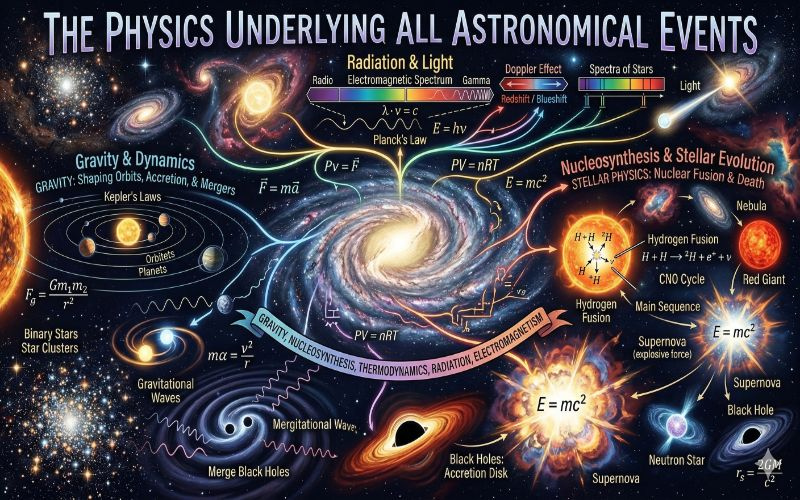
The Physics Underlying All Astronomical Events
Before examining individual phenomena, it helps to understand the forces behind all of them. Three physical processes account for essentially everything we observe in the night sky.
- Gravity shapes the large-scale structure of the universe , drawing matter into stars, stars into galaxies, and galaxies into vast cosmic filaments. It governs orbital mechanics, tidal forces, and the ultimate fate of massive objects. General relativity, Einstein’s 1915 theory of gravity, remains our most accurate description of how gravity operates at astronomical scales, and it predicts several phenomena , including black holes and gravitational waves , that were confirmed only in the 21st century.
- Nuclear fusion powers stars, including our Sun. When hydrogen nuclei fuse to form helium under the extreme pressure and temperature of a stellar core, the mass difference is converted to energy via Einstein’s E = mc². This process generates the light and heat that make planetary life possible and drives virtually every phenomenon associated with active stars.
- Electromagnetism governs how charged particles interact with magnetic fields , the mechanism behind auroras, solar flares, and the jets of plasma that extend hundreds of thousands of light-years from active galactic nuclei.
Eclipses: Precision Geometry on a Cosmic Scale
A solar eclipse occurs when the Moon passes directly between Earth and the Sun, casting its shadow on a narrow path across Earth’s surface. What makes total solar eclipses particularly remarkable , and somewhat improbable , is a coincidence of scale: the Sun is approximately 400 times wider than the Moon, but also approximately 400 times farther away. This means both objects appear nearly identical in angular size from Earth, allowing the Moon to cover the Sun’s disc almost perfectly during totality.
During the 2–7 minutes of a total solar eclipse, several phenomena become visible that are ordinarily impossible to observe: the solar corona (the Sun’s outer atmosphere, extending millions of kilometres into space), prominences (loops of superheated plasma arching above the solar surface), and Baily’s beads (points of sunlight shining through the valleys and craters along the Moon’s limb just before and after totality). The April 2024 total solar eclipse across North America drew millions of observers and produced significant scientific data on the corona.
Lunar eclipses occur when Earth’s shadow falls on the Moon. The reddish colour that gives a total lunar eclipse its popular name , “blood moon” , results from the same physics that makes sunsets red. Earth’s atmosphere refracts and filters sunlight, allowing only longer red wavelengths to bend around the planet and reach the Moon’s surface. Unlike solar eclipses, lunar eclipses are visible from the entire night side of Earth simultaneously.
The next total solar eclipse visible from North America will occur on August 23, 2044, while several annular and partial eclipses will occur in the intervening years. NASA maintains a comprehensive eclipse prediction database for planning purposes.
Auroras: Solar Wind Made Visible
The aurora borealis (northern lights) and aurora australis (southern lights) are among the most visually spectacular phenomena accessible from Earth’s surface, and their mechanism is a beautiful demonstration of electromagnetic physics.
The Sun continuously streams charged particles , mostly electrons and protons , into space as the solar wind. Earth’s magnetosphere deflects most of this stream, but near the polar regions, the magnetic field lines converge and channel particles down into the upper atmosphere. When these particles collide with atmospheric gases at altitudes of 100–300 kilometres, they excite the gas molecules to higher energy states; when the molecules return to their ground state, they release energy as photons of light.
The colour depends on which gas is involved and at what altitude the collision occurs. Oxygen at around 100 km produces the vivid greens most commonly seen. Oxygen at higher altitudes (200+ km) produces rarer reds. Nitrogen contributes blues and purples. The specific mix of colours on any given night depends on solar wind intensity and the altitude distribution of particle impacts.
Aurora activity follows the Sun’s approximately 11-year solar cycle, and we are currently near or at Solar Cycle 25’s maximum, which reached peak activity in 2024 and is expected to remain elevated through 2026. This has produced some of the most widespread aurora displays in decades, with reliable sightings reported as far south as Spain, Florida, and northern India , events that would be exceptional in quieter solar periods. The NOAA Space Weather Prediction Center provides 3-day aurora forecasts and real-time geomagnetic storm alerts.
Comets: Ice-Dust and Deep Time
Comets are among the oldest objects in the solar system , frozen remnants of the protoplanetary disc that formed around our Sun approximately 4.6 billion years ago. Most originate in either the Kuiper Belt (beyond Neptune) or the much more distant Oort Cloud, a spherical shell of icy bodies that extends roughly one to two light-years from the Sun.
As a comet approaches the inner solar system, solar radiation heats its icy nucleus, causing frozen gases and dust to sublimate directly into space , a process called outgassing. This creates the visible coma (the fuzzy atmosphere surrounding the nucleus) and two distinct tails: the ion tail, which always points directly away from the Sun as solar wind pushes ionised gas; and the dust tail, which curves along the comet’s orbital path.
Comets are scientifically significant partly because they may carry organic molecules and water ice that contributed to Earth’s early oceans and possibly to the chemical precursors of life. The ESA’s Rosetta mission, which orbited Comet 67P/Churyumov-Gerasimenko from 2014 to 2016 and deployed the Philae lander on its surface, confirmed the presence of complex organic compounds on the comet , a landmark result in astrobiology.
The most awaited near-term comet event is Comet C/2024 G3 (ATLAS), which passed perihelion in January 2025 and was briefly visible to the naked eye in the southern hemisphere. Long-period comets like this one remain inherently unpredictable in their brightness, but well-observed ones attract enormous public interest.
Meteor Showers: The Solar System’s Annual Calendar
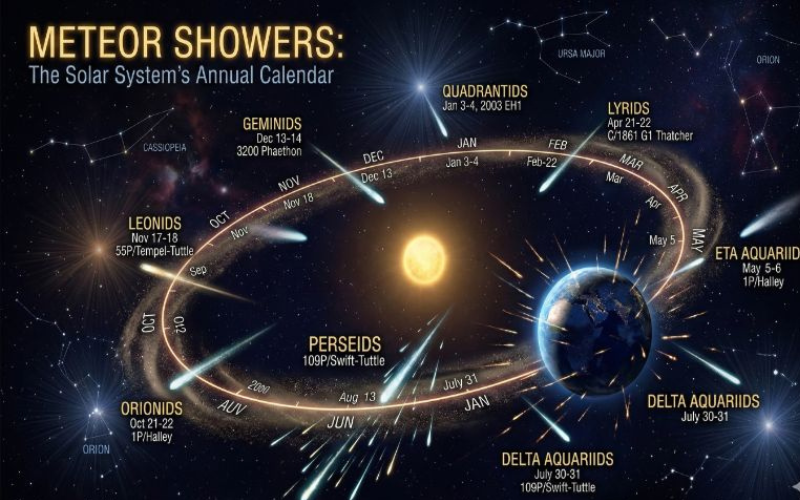
Meteors are the visible result of small particles , typically grains of comet or asteroid debris ranging from the size of a pea to a marble , burning up in Earth’s atmosphere at speeds of 11 to 72 kilometres per second. The brief streaks of light they produce result from the intense heating of the surrounding air, not the particle itself burning.
Meteor showers occur when Earth passes through the debris trail left by a comet along its orbital path. Because all the particles in the trail travel in approximately the same direction, meteors appear to radiate from a single point in the sky (the radiant) , giving each shower its name based on the constellation where that point appears. The Perseids (peaking around August 11–13 each year) originate from debris left by Comet 109P/Swift-Tuttle. The Leonids (mid-November) come from Comet 55P/Tempel-Tuttle and can occasionally produce spectacular storms of hundreds of meteors per hour during peak years.
No special equipment is needed for meteor watching , a dark sky, a reclining position, and patience are all that is required. The key variable is the Moon: a bright Moon near its full phase will wash out fainter meteors significantly. Checking the lunar phase before planning a meteor shower observation is always worthwhile.
Supernovae: Stellar Death as Cosmic Creation
When a massive star , roughly eight times the mass of the Sun or greater , exhausts its nuclear fuel, the outward pressure that has counteracted gravity for millions or billions of years suddenly ceases. The core collapses in less than a second, rebounding in a shockwave of incomprehensible violence. The resulting explosion, a core-collapse supernova, briefly outshines its entire host galaxy and disperses most of the star’s mass into the surrounding space.
This dispersal is not merely destructive , it is the primary mechanism by which elements heavier than iron are distributed through the cosmos. The carbon in our bodies, the oxygen we breathe, the iron in our blood: all were forged in stellar interiors or in the violence of supernova explosions and scattered across space to be incorporated into later generations of stars, planets, and eventually life.
The most recent supernova visible to the naked eye was SN 1987A, observed in the Large Magellanic Cloud (a satellite galaxy of the Milky Way) in February 1987. Astronomers continue to study its expanding remnant with every available telescope. The James Webb Space Telescope (JWST) has produced extraordinary new images of SN 1987A’s ring system, revealing previously undetectable structure in the shock-illuminated gas.
A second category of supernova , the Type Ia , occurs in binary star systems when a white dwarf accretes enough mass from a companion to exceed a specific mass threshold (the Chandrasekhar limit) and undergoes thermonuclear runaway. Because Type Ia supernovae always explode at approximately the same luminosity, they serve as “standard candles” for measuring cosmic distances , a method that led directly to the 1998 discovery that the universe’s expansion is accelerating, driven by what we now call dark energy.
Black Holes: Where Physics Meets Its Limits
A black hole forms when sufficient mass is compressed into a small enough volume that the gravitational field becomes too strong for anything , including light , to escape. The boundary of no return is called the event horizon. It is not a physical surface but a threshold, and crossing it from the outside is a one-way journey.
Black holes come in three main categories. Stellar-mass black holes (roughly 5 to 100 times the Sun’s mass) form from the core collapse of massive stars. Intermediate-mass black holes (hundreds to thousands of solar masses) are rarer and less well understood. Supermassive black holes , millions to billions of solar masses , reside at the centres of most large galaxies, including our own Milky Way.
In April 2019, the Event Horizon Telescope collaboration released the first direct image of a black hole’s shadow , the supermassive black hole at the centre of galaxy M87, 55 million light-years away. In 2022, they followed with an image of Sagittarius A*, the 4-million-solar-mass black hole at the centre of the Milky Way , approximately 26,000 light-years from Earth. These images were made possible by linking radio telescopes across multiple continents to form a virtual telescope the size of Earth itself.
The 2015 detection of gravitational waves , ripples in spacetime produced by two merging black holes , by the LIGO observatory opened an entirely new window on the universe. Gravitational wave astronomy allows us to observe phenomena that produce no electromagnetic radiation and would otherwise be completely invisible.
Planetary Transits and Alignments
A transit occurs when a smaller body passes across the disc of a larger one as seen from a specific vantage point. Transits of Mercury and Venus across the Sun have historically been enormously important in astronomy; 18th-century expeditions to observe the 1769 transit of Venus from multiple locations around the globe allowed the first accurate calculation of the Earth-Sun distance (the astronomical unit).
Today, the transit method is the primary technique used by space telescopes , including the now-retired Kepler and the active TESS , to discover exoplanets. When a planet crosses its host star, it causes a slight, periodic dimming of starlight that reveals both the planet’s existence and its orbital period. Over 5,700 exoplanets have been confirmed using this and other methods, fundamentally transforming our understanding of how common planetary systems are in the galaxy.
Upcoming Astronomical Events Worth Watching
For observers planning ahead, several significant events are approaching. The Perseid meteor shower peaks every August and consistently delivers the most rewarding viewing of the annual shower calendar. Comet activity remains worth monitoring through 2025 as several periodic and newly discovered comets are being tracked. The Leonid meteor shower in November occasionally produces exceptional displays. And aurora watchers should remain alert through the current solar maximum period, which is expected to sustain elevated geomagnetic activity through at least late 2025.
For real-time updates, sky charts, and event predictions, NASA’s Solar System Exploration site and TimeandDate.com’s astronomy section provide reliable, up-to-date information accessible to observers at all levels.
Astronomical Phenomena and Human History
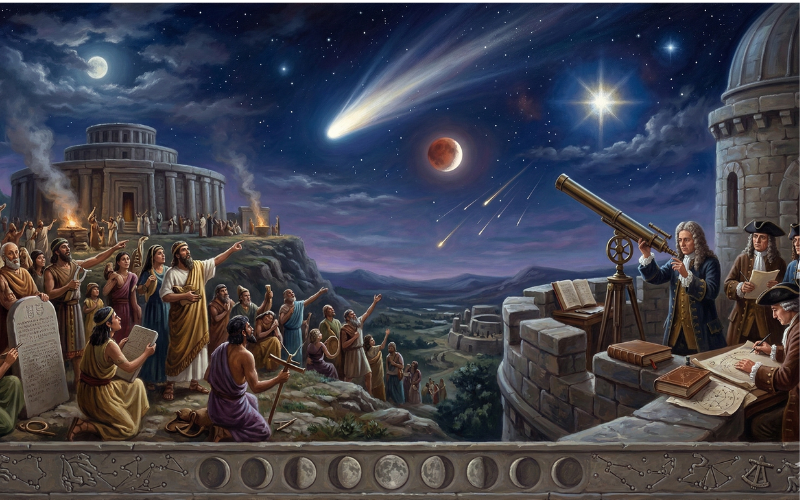
The history of astronomy is inseparable from the history of civilization. Ancient Egyptians aligned the Great Pyramid at Giza with stellar positions. Stonehenge marks the solstices with remarkable precision. Polynesian navigators used star patterns to cross the Pacific Ocean without instruments. The Babylonians developed sophisticated eclipse prediction systems more than 2,500 years ago. And the European scientific revolution that gave us Newton, Galileo, and Kepler was driven largely by the need to understand and predict the movements of celestial bodies.
The profound human response to astronomical phenomena , wonder, fear, reverence, curiosity , has not diminished with scientific understanding. If anything, understanding what a supernova actually is , that it seeded the cosmos with the atoms now inside every human body , makes the sky more extraordinary, not less.
The Universe as an Ongoing Story
Every astronomical phenomenon is a chapter in a story that began 13.8 billion years ago with the Big Bang and continues in every direction we point a telescope. We live at an extraordinary moment in this story’s telling: the JWST is showing us galaxies forming within the first few hundred million years of the universe’s existence. Gravitational wave detectors are listening for the merger of neutron stars. Radio telescopes are mapping the cosmic web of dark matter filaments that structure everything we see.





- Be Respectful
- Stay Relevant
- Stay Positive
- True Feedback
- Encourage Discussion
- Avoid Spamming
- No Fake News
- Don't Copy-Paste
- No Personal Attacks
- Be Respectful
- Stay Relevant
- Stay Positive
- True Feedback
- Encourage Discussion
- Avoid Spamming
- No Fake News
- Don't Copy-Paste
- No Personal Attacks
