Top Funny Poems to Brighten Your Day
Published: 3 Mar 2026
There is a particular kind of relief that comes from a well-timed joke in verse form , the double satisfaction of a clever rhyme landing exactly where it should, carrying a punchline you almost saw coming but didn’t quite. Funny poetry is one of the oldest and most democratic forms of literature. It requires no prior knowledge of any canon, no patience for ambiguity, and no tolerance for pretension. It just needs to make you laugh.
This collection brings together original funny poems on relatable everyday subjects, alongside a genuine exploration of what makes comic verse work , the techniques, the history, and the poets who perfected it.
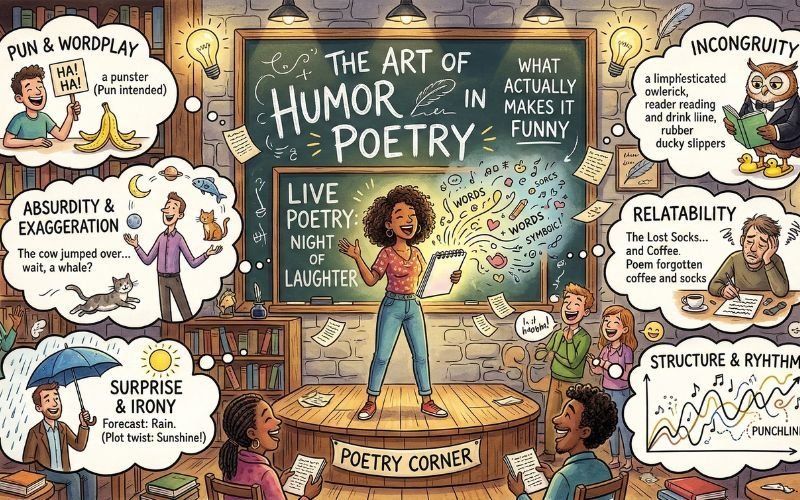
The Art of Humor in Poetry: What Actually Makes It Funny
Comic poetry is harder to write well than it looks. The constraint of rhyme and meter that makes verse feel inevitable and satisfying is also an unforgiving trap , a forced rhyme kills a joke faster than almost anything else. The best funny poets make the form feel effortless while working under considerable technical pressure.
Several specific techniques do most of the heavy lifting in successful comic verse.
- The turn: The best funny poems set up an expectation and then pivot sharply at the last moment. The reader thinks they know where the poem is going, and the poet goes somewhere else entirely. This is the poetic equivalent of a punchline, and its timing is everything.
- Bathos: The deliberate deflation of something grand or elevated into something trivial. A poem that begins with epic, heroic language and ends describing a lost sock is using bathos. It was a favourite technique of Alexander Pope and remains one of the most reliable tools in the comic poet’s kit.
- Hyperbole: Extreme exaggeration, deployed deadpan. The humour comes from the gap between the scale of the language and the triviality of the subject. Ogden Nash was a master of this.
- Comic rhyme: Near-rhymes, forced rhymes, and unexpected rhymes used deliberately to comic effect. When a rhyme is too perfect it can feel inevitable; when it is slightly off, or arrives in an unexpected place, it produces a small jolt of delight.
- Incongruity: Placing things side by side that have no business being together. A fly offering wine recommendations. A cat demanding breakfast before philosophical discussion. The more mundane one element and the more elevated the other, the funnier the collision.
Original Funny Poems: Verses for Every Occasion
A little absurdity, a dash of exaggeration, and a pinch of rhythm here’s an original light-hearted poem to brighten your day.
1. The Peril of Spaghetti
I tried to eat spaghetti, oh so neat, But it wrapped around my fork in a twisty feat. One noodle slapped me right on the chin, another dove straight into my grin.
The sauce leapt left, then veered back right, It splattered my shirt like it wanted a fight. I twirled and I stabbed and I slurped with great care. By the end I had pasta behind my left ear.
By the time I was done, what a messy affair, Spaghetti in my lap, and sauce in my hair. The chef peered out from behind the kitchen door and quietly retired to a career offshore.
2. The Laundry Monster
My laundry pile is alive, I swear, It growls and groans when I walk near. Socks that entered as a pair Emerge as singles , gone somewhere.
Shirts I folded, neat and right, have crumpled back to spite me overnight. The jeans I swore I’d washed last week have developed their own mystique.
I should tackle it. Face it down. Sort the colours. Fight the gown. But wisdom whispers, clear and bright: I’ll just close the door tonight.
3. The Alarm Clock’s Revenge
My alarm clock has a mind of its own, It rings so loud, like a megaphone. I hit snooze once, then maybe twice, It screams, “Wake up! That’s not so nice!”
At 6 AM it sounds like war, At 6:09 , considerably more. It rattles the window. Startles the cat. No reasonable clock should behave like that.
But when I’m late and rushing in shame, searching for someone sensible to blame , the clock just blinks its 12:00 face, serene and blinking in its place.
4. The Tale of the Talking Cat
My cat stared at me with a curious glare, then opened his mouth and said, “Beware!” I jumped so high I spilled my tea, “Did you just talk? Or was that me?”
He rolled his eyes and gave a sigh, The kind reserved for humans who try. “I’ve spoken for years. You weren’t listening. Now , the bowl. It needs replenishing.”
I filled it up, still shocked to the core. He ate, cleaned his paws, and said nothing more. Since then every morning I check his face , He stares at the wall with impeccable grace.
5. The Fly in the Soup
I found a fly in my soup today, It looked at me as if to say: “This broth’s quite nice, but could use more spice, And perhaps a splash of Chardonnay.”
He flagged the waiter with one small leg and asked about the chef’s pedigree. “The garnish lacks ambition,” he said, Then critiqued the bread and the cutlery.
I sighed and laughed and slid him the bill. He reviewed the dessert menu with great goodwill. I left him a five-star review that night: Best insect dining experience. Highly polite.
6. The Dog and the Doorbell
Every time the doorbell rings, My dog does extraordinary things: He spins three times, barks at the door, then barks at the wall, then barks at the floor.
He bolts to the window, then back to the hall, Alarmed by a noise he made himself recall. The postman has left. The threat has passed. He barks at the silence, satisfied at last.
Then circles back to his bed with a sigh, And sleeps , one ear cocked for the danger nearby. The doorbell and dog have reached a détente: He’ll never relax. It will never relent.
7. My To-Do List
This morning I wrote a magnificent list of tasks I intended and things I had missed. “Fix the shelf. Call the dentist. Reply to the bank. Water the plants (they are starting to thank me).”
By ten I’d made coffee and stared at the wall. By noon I’d rearranged nothing at all. At three I reorganised the list itself , Colour-coded, and placed it on the shelf.
Tomorrow I’ll tackle the actual things. Tonight I’ll admire what good planning brings: A perfectly formatted, colour-blocked sheet , And evidence of a productive week.
Notable Poets of Funny Verse: The Masters of Comic Form
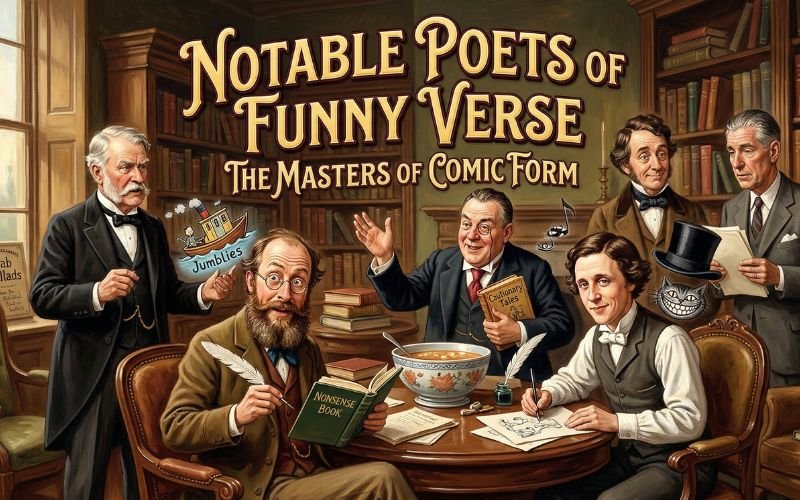
Across centuries and continents, a handful of writers have elevated comic poetry into a serious literary art , blending wit, rhythm, satire, and surprising emotional depth.
- Ogden Nash (1902–1971) is the undisputed champion of American comic poetry. His signature technique was the wildly uneven line , stretching a verse to absurd length to accommodate a rhyme so forced it circles back to brilliance. Nash understood that humor and melancholy are close neighbours, and his best poems are genuinely moving beneath the laughter.
- Dorothy Parker (1893–1967) wrote comic verse with the sharpness of a scalpel. Her humour was frequently self-deprecating and darkly satirical, targeting social conventions, romantic disappointment, and the particular absurdities of early 20th-century New York. Her four-line poems , epigrammatic and devastating , are among the finest in the English language.
- Edward Lear (1812–1888) invented the modern limerick and pioneered literary nonsense with The Owl and the Pussycat and The Jumblies. His work has an internally consistent dream logic that delights children and continues to fascinate linguists and literary theorists; nonsense, it turns out, requires extraordinary precision to carry off.
- Shel Silverstein (1930–1999) understood that the best funny poems for children work just as well for adults, because the best humor is always accessible. Where the Sidewalk Ends and A Light in the Attic introduced generations of children to the idea that poems could make you laugh until you cried, and they hold up completely for adult readers revisiting them.
- Spike Milligan (1918–2002) brought a surrealist, anarchic energy to British comic verse. His poetry is frequently dark, often absurd, and occasionally genuinely profound , sometimes all three at once.
How to Write Your Own Funny Poem: A Practical Guide
Writing comedy is difficult, but the specific challenge of comic verse is useful because the constraints of form give you guardrails. Here is a practical approach that works for beginners and experienced writers alike.
- Start with a specific, relatable frustration. Not “modern life is stressful” but “my phone battery dies at 4% every single time.” The more specific the premise, the funnier the poem can be , generality is comedy’s enemy.
- Decide on your form early. Limericks (AABBA rhyme scheme) are the most forgiving comic form , the rhythm almost does the work for you. Four-line stanzas with an ABAB or AABB rhyme scheme work well for longer comic narratives. Free verse is harder for comedy because it removes the mechanic of the unexpected rhyme.
- Write your punchline first, then build toward it. This is backwards from how stories are usually written but essential for comic poetry. Once you know exactly where you are going, you can engineer the approach to make the arrival as surprising as possible.
- Let the rhyme lead you somewhere unexpected. When you find a rhyme that surprises even you, that’s almost certainly your best line. Follow it.
- Read it aloud before you consider it finished. Comic verse lives or dies in performance. If the rhythm stumbles when you read it aloud, it will trip the reader too. The metre must be smooth enough that the reader can move through the poem at speed , because comedy requires timing, and timing requires pace.
Funny Poetry in Contemporary Culture
Comic verse has found an extraordinarily natural home in social media. The strict character limits of Twitter/X lent themselves to epigrammatic wit in the tradition of Dorothy Parker. Instagram poetry accounts dedicated to humorous verse attract millions of followers. And the “poetry meme” , a few lines of wry verse overlaid on a relatable image , has become one of the most shared formats on the internet.
Poets like Rupi Kaur opened mainstream audiences to short-form verse, and a generation of comic poets has followed with deliberately playful responses to that earnest tradition. Brian Bilston, often called “the poet laureate of Twitter,” builds comic poems with structural jokes built into their visual form. Atticus’s combination of romantic and gently humorous verse has found enormous readership on Instagram.
What this explosion of popularity demonstrates is something comic poets have always known: people who claim not to like poetry almost invariably like funny poems. The form is accessible, immediate, and offers the particular pleasure of language used with precision toward a specific and enjoyable end.
The Enduring Case for Funny Poems
Aristotle identified comedy as one of the fundamental modes of human expression, alongside tragedy. The two are not opposites , the best comic poetry, like the best comedy in any form, usually has something true and slightly painful at its core. The spaghetti poem is about the chaos of ordinary life not going as planned. The laundry poem is about avoidance and small private failures. The alarm clock poem is about the daily negotiation between who we want to be and who we actually are at 6 AM.



- Be Respectful
- Stay Relevant
- Stay Positive
- True Feedback
- Encourage Discussion
- Avoid Spamming
- No Fake News
- Don't Copy-Paste
- No Personal Attacks
- Be Respectful
- Stay Relevant
- Stay Positive
- True Feedback
- Encourage Discussion
- Avoid Spamming
- No Fake News
- Don't Copy-Paste
- No Personal Attacks
