It sits in nearly every desk drawer, kitchen junk drawer, and classroom supply bin in the world. It costs almost nothing, fixes almost anything temporarily, and has been around for nearly a century. Scotch tape is so familiar that most people have never thought to wonder how it works, where it came from, or why it is called “Scotch” in the first place.
This guide covers all of it , the genuine history, the science behind the adhesive, every type available today, the surprisingly wide range of uses (including several most people don’t know), and what has changed in the product’s century of evolution.
The Accurate History of Scotch Tape
The story of Scotch tape begins not with office supplies but with the American automobile industry.
In the 1920s, car manufacturers began producing two-tone painted vehicles, which required painters to mask off areas of the car body cleanly so the two colours would not bleed into each other. The masking tapes available at the time were unreliable , they either adhered too aggressively and damaged paint when removed, or not aggressively enough and allowed paint to seep underneath.
Richard Drew, a young laboratory technician at the Minnesota Mining and Manufacturing Company (now known as 3M), was visiting an auto body shop in 1925 when he witnessed painters struggling with exactly this problem. Drew, who had no formal engineering training, took it upon himself to solve it. After two years of experimentation, he developed a reliable masking tape in 1925 , his first major invention.
By 1929, Drew turned his attention to a different problem. Manufacturers of insulation materials needed a way to seal moisture-proof packaging, and the tapes available were either too bulky or too expensive. Drew began experimenting with a transparent cellulose-based backing coated with a pressure-sensitive adhesive. In 1930, he completed the development of the world’s first transparent adhesive tape , the product that would become Scotch tape.
Why Is It Called “Scotch”?
The name has nothing to do with Scotland. According to the most widely documented account, when Drew presented an early prototype of his masking tape to an auto body painter, the adhesive had been applied only along the edges of the tape rather than across its entire width , a cost-saving measure during development. The frustrated painter reportedly said something along the lines of “Take this tape back to your Scotch bosses and tell them to put more adhesive on it” , using “Scotch” as a colloquial term for cheapness or stinginess, in the way the word was sometimes used in American slang of that era.
3M, recognising the catchiness of the name, adopted it for the product line rather than trying to distance themselves from it. The name stuck, and Scotch tape became one of the most recognised brand names in the world.
The timing of the product’s launch , 1930, the first year of the Great Depression , proved commercially significant. People who could not afford to replace torn documents, broken household items, or worn clothing found that a cheap roll of transparent tape could extend the life of almost everything. Sales were driven as much by economic necessity as by novelty.
How Scotch Tape Works: The Science of Pressure-Sensitive Adhesion
Scotch tape uses a pressure-sensitive adhesive (PSA), which means it forms a bond when light pressure is applied, without requiring heat, water, or solvents to activate it. This is fundamentally different from glue, which requires a chemical reaction or solvent evaporation to set.
The adhesive is typically an acrylic polymer or rubber-based compound that is viscoelastic , meaning it behaves simultaneously like a viscous liquid and an elastic solid. When you press tape onto a surface, the adhesive flows slightly into the microscopic texture of the surface, maximising contact area and creating adhesion through a combination of van der Waals forces (weak intermolecular attractions that become significant when two surfaces are very close together) and mechanical interlocking with surface textures.
When you peel the tape, the elastic properties of the adhesive allow it to stretch and release rather than tearing the surface , provided the peel is done at an appropriate angle and speed. Peeling slowly at a low angle tends to leave more residue; peeling quickly at a high angle (close to 90 degrees) typically results in a cleaner removal.
The backing material , the clear film you see , is typically made from one of the following:
- Cellulose acetate: The original material used by 3M, derived from plant cellulose. It has a slight crinkle when bent, is biodegradable over time, and is the material used in classic Scotch Magic Tape.
- Biaxially oriented polypropylene (BOPP): A plastic film used in most modern packaging tapes, offering greater strength and moisture resistance.
- Polyester (PET): Used in specialty tapes requiring higher strength and temperature resistance.

Every Type of Scotch Tape and What Each Is Best For
3M’s Scotch brand now encompasses dozens of distinct tape products. Here is a practical breakdown of the most commonly available types:
- Scotch Magic Tape , The iconic matte-finish transparent tape that appears invisible on paper when applied. It is writable, meaning you can mark on it with a pen or pencil. The matte finish is the result of a microscopically roughened surface on the adhesive side, which scatters light and eliminates glare. Best for: wrapping gifts, mending torn paper documents, labelling, general office and school use.
- Scotch Transparent Tape , The glossy, fully clear version of standard tape. More reflective than Magic Tape but slightly stronger hold. Best for: sealing envelopes, quick repairs, applications where transparency matters more than writability.
- Scotch Double-Sided Tape , Adhesive on both sides of the backing, with a release liner protecting one side until use. Best for: mounting photos, crafting, scrapbooking, securing tablecloths or decorations, hemming fabric temporarily.
- Scotch Heavy Duty Shipping and Packaging Tape , Significantly thicker backing (typically BOPP) with a stronger, more aggressive adhesive. Designed to hold cardboard boxes securely even under heavy loads. Best for: sealing shipping packages, moving boxes.
- Scotch Washi Tape , A decorative tape with a paper-like texture made from Japanese washi (traditional paper). Typically patterned, semi-transparent, and easily removable without residue. Best for: decorating journals, bullet journaling, scrapbooking, crafts, labelling, decorating without wall damage.
- Scotch Mounting Tape , A foam-core double-sided tape designed for mounting objects on walls. The foam layer absorbs vibration and compensates for slight surface unevenness. Best for: hanging lightweight frames, decorations, and signs without nails.
- Scotch Removable Tape , A lower-tack version designed to be repositioned and removed without leaving residue or damaging surfaces. Best for: temporary signage, notes on walls, protecting surfaces.
- Scotch Masking Tape , The original product from Richard Drew’s 1925 invention. A beige, slightly textured paper tape with medium adhesion. Best for: painting edges, labelling containers, bundling items, craft projects.
- Scotch Electrical Tape , Not typically included in consumer Scotch product lines, but worth noting: electrical tape from various manufacturers serves a completely different function, providing insulation and moisture resistance for electrical connections.
Uses of Scotch Tape: Common-Creative-and Unexpected
Far beyond simple wrapping and repairs, Scotch tape serves a surprising range of practical and inventive purposes.
Everyday Household Uses
The obvious applications , wrapping gifts, repairing torn pages, sealing envelopes , are only the beginning. Around the home, Scotch tape also serves as an emergency hem (fold up a trouser leg and tape it internally for a temporary fix), a cable organiser (loop a strip to hold charging cables on a desk edge), a paint protector (apply along edges before painting a wall), and a splinter remover (press tape firmly over a splinter and pull , effective for splinters near the surface).
Office and Professional Uses
In offices, tape secures documents, holds presentations together, and repairs important papers. A widely underappreciated office use: applying a strip of Magic Tape over a barcode before writing on the label prevents ink from smearing. In photography studios, gaffer tape (a close relative) and regular Scotch tape are both used extensively for marking positions on floors and securing backdrops.
Crafting and Educational Uses
In classrooms and craft studios, Scotch tape is foundational to paper craft, model making, collage work, and temporary assembly of components before permanent fixing. Washi tape in particular has developed an enormous creative following, with dedicated communities sharing decorative uses in journaling, home decoration, and seasonal displays.
Scientific Uses
One of the most remarkable uses of Scotch tape in science is the discovery that led to a Nobel Prize. In 2004, physicists Andre Geim and Konstantin Novoselov at the University of Manchester used ordinary Scotch tape to repeatedly peel thin layers from a graphite crystal, eventually isolating graphene , a single layer of carbon atoms arranged in a hexagonal lattice. This technique, called the Scotch tape method or mechanical exfoliation, produced a material that is simultaneously the thinnest, lightest, and strongest material ever measured. Geim and Novoselov were awarded the Nobel Prize in Physics in 2010 for this discovery , and the tool that made it possible was a product from any office supply drawer.
Additionally, it has been documented that peeling Scotch tape in a vacuum produces triboluminescence , a faint X-ray emission caused by the rapid charge separation as the adhesive separates from its backing. This phenomenon was sufficient, under controlled laboratory conditions, to produce an X-ray image. While not practically useful, it is a genuine and verified scientific curiosity.
Innovations in Scotch Tape: What Has Changed
The core product has remained remarkably stable since 1930, but the tape category has evolved considerably around it.
Eco-friendly formulations have become increasingly important. 3M now offers Scotch tape products with backings made from plant-based or recycled materials. Magic Tape has been reformulated to use a backing derived from renewable plant cellulose rather than petroleum-based plastics, aligning with growing consumer expectations around sustainability.
Improved removability has been a focus of recent development. Low-residue and zero-residue formulations allow tape to be used on painted walls, photographs, and delicate surfaces without damage , a significant improvement over earlier products that often left yellowed, sticky marks over time.
Specialty surface formulations now address materials that adhesive tapes historically struggled with: very smooth surfaces like glass, textured surfaces, low-energy plastics, and fabric. Each requires a different adhesive chemistry and surface treatment.
Temperature-resistant variants extend the use of tape into environments , near ovens, in cold storage facilities, in outdoor applications , where standard tapes would fail.
Scotch Tape vs Other Common Adhesive Tapes
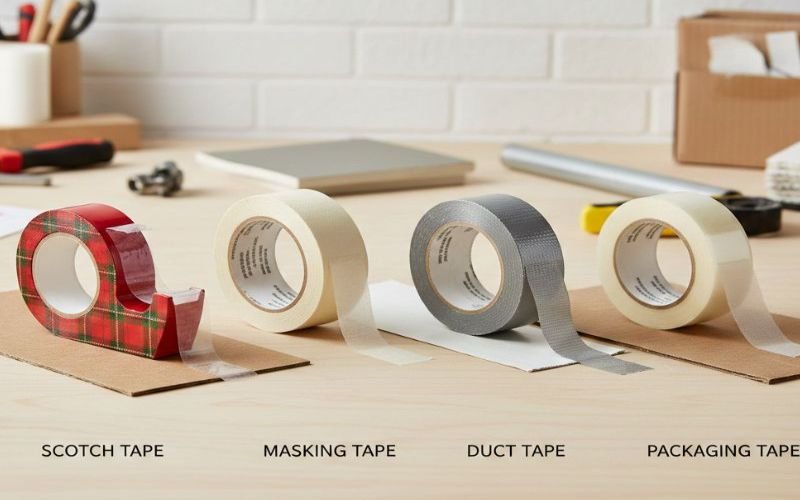
Understanding where Scotch tape fits in the broader tape landscape helps in choosing the right product for each task.
| Tape Type | Best For | Key Difference from Scotch |
| Gaffer Tape | Film/stage production, temporary cable management | Cloth-backed, very strong, cleaner removal than duct tape |
| Duct Tape | Heavy-duty repairs, waterproofing | Much stronger hold, leaves residue, not transparent |
| Masking Tape | Painting edges, crafting | Paper-backed, easily tearable by hand, lower adhesion |
| Washi Tape | Decoration, crafting | Decorative, paper-based, highly removable |
| Electrical Tape | Insulating electrical connections | Specialised insulation properties, stretchy |
| Foam Mounting Tape | Hanging objects on walls | Foam core for thickness and vibration absorption |
Why Scotch Tape Remains Indispensable Nearly 100 Years Later
The enduring appeal of Scotch tape is a case study in what makes a product genuinely useful. It solves a wide range of small but real problems cheaply, reliably, and without requiring skill or instruction. It works immediately, leaves no mess, requires no drying time, and can be undone if applied incorrectly. For a product category that has seen virtually no major disruption in nearly a century, that is a remarkable achievement.
The 3M brand and the underlying technology have also proven adaptable enough to evolve with changing consumer needs , eco-friendly materials, decorative variants, removable formulations , without abandoning the core simplicity that made the original product successful.
For a comprehensive look at 3M’s full range of Scotch products and their specific applications, the 3M Scotch brand website provides detailed specifications. For historical context on the invention and Richard Drew’s work, the 3M Innovation Stories archive is the authoritative primary source.